.

.
Click above for what became the consented plan, plus Transport page.

2013-04-13

"Speed Kills: The Complex Links Between Transport, Lack of Time and Urban Health"


Link to NIH web site

"Road safety experts understand the contribution of speed to the severity and frequency of road crashes. Yet, the impact of speed on health is far more subtle and pervasive than simply its effect on road safety.

The emphasis in urban areas on increasing the speed and volume of car traffic contributes to ill-health through its impacts on local air pollution, greenhouse gas production, inactivity, obesity and social isolation.

"In addition to these impacts, a heavy reliance on cars as a supposedly ‘fast’ mode of transport consumes more time and money than a reliance on supposedly slower modes of transport (walking, cycling and public transport). Lack of time is a major reason why people do not engage in healthy behaviours."

2013-04-11

Barnet Times


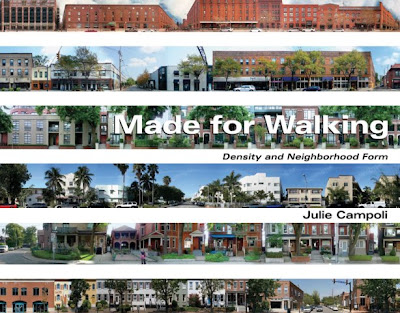
"Made for Walking: Density and Neighborhood Form"


Link to PPS web site

"Arguments about density are often front and center when walkability is being discussed. We know that density is an important factor in encouraging more walking (and discouraging driving), but walkability is a particularly complex, and seemingly ephemeral quality. 

"Whether or not a person chooses to walk depends on so many factors beyond just the physical fabric of a place, from the socioeconomic to the psychological. As a result, there’s not always a one-to-one relationship between a neighborhood’s form and its walkability.

"... The results here seem to support an argument that Placemaking advocates have been making for some time now: that it is not physical density itself, but the richness of a place that influences peoples’ decisions on whether to walk or use other modes of transportation to get around their communities. 

"A dense place may very well still be a total place desert depending on how it is arranged, while there are scores of small towns and villages around the world that, while not physically dense, feature a rich mix of overlapping uses that make walking the default choice."

Evening Standard: "Household debt will decide UK recovery"


Link to
web site
"Do British households have too much debt? Or to put it another way, do British households feel they have too much debt to allow them to start spending? On this question hang the prospects for our economic recovery.

"Opinions on the issue diverge. The Treasury’s official forecaster, the Office for Budget Responsibility, seems to take the view that the great wave of household deleveraging is abating. ...

"However, not everyone agrees with this sanguine forecast. The International Monetary Fund, in its most recent comprehensive report on the UK economy, argues that deleveraging by British households probably has further yet to run. More ominously, it sees house prices as overvalued by 10-15%.

"...  The Chancellor’s state home-buying guarantees for first-time buyers with small deposits, announced in the March Budget, look irresponsible given the possibility that the housing market could well have a correction in store. A 5% slide in house prices would put these new buyers in negative equity. 

"A more prudent alternative to the problem of young families priced out of the housing market would be, instead, for the Government to boost the housing supply by sponsoring the construction of more homes."

2013-04-10

GLA: "Open for Business - Empty Shops on London’s High Streets"


Link to GLA web site

"Our report sets out a package of emergency and longer term measures to break the vicious cycle on the high street, which has led to an increase in empty shops across the capital – up five per cent to 3,400 in the past two years.

"Open for Business says outer London high streets are particularly struggling, predominantly because of tough economic conditions, and because people increasingly shop at out-of-town centres and online."

Cycling to Brent Cross? Remember that "Baronets should not be called upon to wear the same cycling uniform as bricklayers"


Link above to 'RoadsWereNotBuiltForCars'
(or to the Famous Five Barnet bloggers)

"In 1878, the uniform of the newly-formed Bicycle Touring Club – forerunner to Cyclists’ Touring Club’ (CTC) – was meant to consist of 'dark green Devonshire serge jacket, knickerbockers, Stanley helmet with small peak, and Cambridge grey stockings'." 

 The British Library holds a copy of CTC’s Uniform rules & regulations, London, 1888. This small pamphlet – coincidentally produced in the ‘Year of Jack the Ripper’ – offers a chance to see and touch what kind of all-wool clothing members of the Cyclists’ Touring Club rode in. 

"Eminently sensibly, the pamphlet remarks that none of the official garb contained cotton. Modern outdoors people know that cotton absorbs and holds sweat, chilling the wearer. 

However, the CTC’s E.R. Shipton, club secretary and who wrote the uniform guide, described the act of perspiring and the advisability of use of wicking fabrics far more prosaically:
"Cotton [is a] material which is a fatal stumbling block to the proper discharge of the bodily functions when undergoing fatigue.”


Now that people are correctly attired...


Link to 'Brent Cyclists'

"There are some allowed cycle routes across the Welsh Harp Open Space, partially in Brent and partially in Barnet. These are pleasant but not all that useful, and indeed are little-used.

"Brent Cyclists wants to see these paths extended and improved so they connect across the Open Space and West Hendon Playing Fields north to south. Ultimately we think a circular route could and should be created around the reservoir, which would be a very attractive leisure facility, and much needed. Currenly, there is nothing like this in NW London - the nearest extended cycle circuit off-road is in Richmond Park.

"The Welsh Harp has a cycling history. It was the site of the first track races in Britain, and the overgrown stadium can still be seen, just west of the north end of the reservoir. It is still marked 'cycle track' on most maps as if it were still in use - sadly, very far from the case!"

Planning: "Neighbourhood Watch"


Link to 'Planning'

"Welcome to the first installment of Neighbourhood Watch. We’ll be keeping a close eye on the latest neighbourhood planning activity taking place across England.

The project has been launched to build on Planning’s research into neighbourhood planning, a key part of the government’s Localism Act.

"... London’s neighbourhood planning hotspot is Westminster, which has had 15 applications to take on neighbourhood planning powers – one of the highest amounts in the country – and has a tradition of organised and engaged local civic societies, many of which have applied."

Sat 22 June: "Making Noise to Prioritise Pedestrians"


"Living Streets Supporters' Conference 2013"

Saturday, 22 June 2013
Coin Street Neighbourhood Centre, Waterloo, London
10am-4.30pm
Book now!
"There's never been a better time to get campaigning to create better streets in your area. Come along to this free one-day event to find out how to get started or to improve your campaigning techniques."
  • Get advice from other campaigners
  • Seek inspiration from industry experts
  • Attend training workshops
  • View the day's itinerary.
What previous delegates have said:
'I thought the conference very worthwhile, interesting, informative and well organised. Congratulations'

'Thank you - great to meet other campaigners from around the country'

'Gave me a good sense of campaigning on walking and creating walking-friendly streets'
"We will be announcing the winner of the Living Streets 'Charles Maher Award' on the day, which recognises the efforts of individuals, groups, organisations or local authorities who have made a real difference to their streets. Nominations are now open.

"We would also like you to suggest inspirational speakers for the day. Please email ruth.billingham@livingstreets.org.uk with your ideas."

2013-04-09

Wed. 17 April: Brent and Camden United Front (against Barnet, amongst other things?)


"Taking the car out of Corbusier: a car-free sector planned for Chandigarh"


Link to 'The Global Urbanist'

"Henrik Valeur presents a well-developed proposal to turn one neighbourhood or 'sector' in the modernist city of Chandigarh into a car-free area, and the confused behaviour of the authorities attempting to implement the idea."

"... The late architect Aditya Prakash, a member of the original design team for Chandigarh and later the first principal of Chandigarh College of Architecture, said:
"When I was young … we could still use the street for anything that we wanted including sleeping at night. We did not realise while planning urban space that the automobile would be the greatest devastator of a city."
"While Chandigarh was designed in the image of the 'modern' European city without much consideration for the qualities of the traditional Indian city, many European cities are now, without knowing it, trying to adopt the image of the traditional Indian city that Aditya talked about, with fewer cars and more human interaction and activities.

It may be one of the great tragedies of our time that despite all the means and opportunities, we are still not very good at learning from each other, one way or the other."


First 'London Cycling Campaign Policy Forum'


"London's cycling commissioner sets out in detail what he expects to see happening on London's streets over the next three years. All the right noises but now the questions are all around delivery."

Link to CyclistsInTheCity

"Last night, I chaired the first London Cycling Campaign Policy Forum, a meeting organised by Rachel Aldred of the University of Westminster, who is also leading a new informal academic cluster, the "London Cycling Research Group". Lead speaker was London's new Cycling Commissioner Andrew Gilligan.

"Gilligan also provided some updates on the plans for 'Mini-Hollands' - creating cycle-friendly boroughs in outer London. He stressed that 'Not all of the outer boroughs are interested in cycling; some are actively hostile,' but confirmed that he is expecting to award funds to between one and three outer London boroughs, from a pool of seven that have confirmed they want genuinely to embrace cycling as a form of transport."

2013-04-08

[Reposted] Offices to Homes, and a Library Move: Gateway House Finchley proposals


Evening Standard: "Are you being served in your local high street?"


Link to web site

"I am an instinctive shopper and an impatient one. I don’t want to queue, I don’t want to go from minus-2 sleet outside, to the sweltering fan-heat of the store, 

"I don’t want to face hordes of people slamming a heavy swing door in my face, I am too lazy to try anything on (blame Hong Kong) and I never ever want to be told I can get only a credit note if I decide to return it.

"My best friend Jojo is horrified when I confide these thoughts about the high street to her. 'That’s so dangerous,' she tells me. 'What about jobs? What about the economy? And what about depression? If people don’t have that social interaction they will go insane.' I take her thoughts very seriously. They panic me and stop me in my tracks."

"How to Be a Citizen Placemaker: Think Lighter, Quicker, Cheaper"


Link to PPS web site

"Imagine that you live in a truly vibrant place: the bustling neighborhood of every Placemaker’s dreams. Picture the streets, the local square, the waterfront, the public market. Think about the colors, sights, smells, and sounds; imagine the sidewalk ballet in full swing, with children playing, activity spilling out of storefronts and workspaces, vendors selling food, neighborhood cultural events and festivals taking place out in the open air.
"Take a minute, right now. Close your eyes, and really picture it. Now, here’s the million dollar question: in that vision, what are you doing to add to that bustle?

"If vibrancy is people, and citizenship is creative, it follows that the more that citizens feel they are able to contribute to their public spaces, the more vibrant their communities will be. The core function of place, as a shared asset, is to facilitate participation in public life by as many individuals as possible. 

"Ultimately the true sense of a place comes from how it makes the people who use it feel about themselves, and about their ability to engage with each other in the ways that they feel most comfortable."

[Reposted] "Sir Terry Farrell to lead independent review of architecture and the built environment" (Nothing to interest Brent Cross's Hammerson, then)


"World-renowned architect asked to make recommendations to promote high design standards"

"Culture Minister Ed Vaizey has asked world-renowned architect Sir Terry Farrell CBE to make recommendations on promoting high standards of design.

"The review is intended to engage architects, designers and other built environment professionals to help DCMS think about our role in achieving high-quality design, allowing us to better influence and shape policy across government.

"The review will look at four main areas:
  • Understanding the Government’s role in promoting design quality in architecture and the built environment
  • The economic benefits of architecture; maximising the UK’s growth potential
  • Cultural heritage and the built environment
  • Promoting education, outreach, and skills."

Expert panel
 
"Sir Terry Farrell will also be supported by an expert advisory panel of members from across the architecture and design industry who will look at the themes of the review in more detail. 

"Ed Vaizey said:
“Good design builds communities, creates quality of life, and makes places better for people to live, work and play in. I want to make sure we’re doing all we can to recognise the importance of architecture and reap the benefits of good design and I’m delighted Sir Terry Farrell has agreed to undertake this independent review.

I now urge all those within the architecture and built environment industry to make sure they get involved and contribute their views.”
"Sir Terry Farrell said:
“I am delighted to be heading this important review at this time. Many countries have an effective architecture policy and I intend to learn from what has worked elsewhere and also learn from all those involved here in architecture and the built environment. Architecture and the built environment is so important to us culturally, economically, socially and environmentally.”
"The advisory panel will issue a call for evidence shortly and it is expected Sir Terry Farrell will produce a report by the end of the year."

Further information

Thatcher wanted in Finchley


2013-04-06

"Cyclists urge Council to lobby for funds to create new bike lanes"


Link to Brent & Kilburn Times

"Cyclists have called on Brent Council to lobby for funding which could see a multi million pound transformation of the borough turning it into a ‘mini Holland’ cycling paradise. 

"Proposals have been drawn up by Brent Cyclists (BC), which outline how they think the borough could benefit from Mayor of London, Boris Johnson’s plans to improve cycling across the capital.

"The suggestions, which feature in a report made by BC, include a link between Wembley Park and Neasden to combat the problems faced in crossing the railway line and North Circular Road and alterations to roundabouts and roads in the area."


"The [parallel] Sustrans 'Connect London' Campaign
is celebrating a significant step forward, following the release of
Mayor Boris Johnson’s new vision for cycling in London.

Elements of the Mayor’s announcement echo the 'Connect London'
plan which aims to see London become home to the
world’s biggest cycle network by 2020."


"Good News on House Prices": Daily Telegraph: "House prices for first-time buyers up 5pc since summer"


Link to web site

"Efforts to prop up house prices appear to be having the biggest impact on first-time buyers.

"... For those trying to get on to the property ladder, the research shows the struggle many face, as government schemes aimed at encouraging lending appear to be filtering through, and pushing up prices.

"... The Royal Institution of Chartered Surveyors has warned that the [schemes] may merely serve to push up prices of these homes, to the benefit of house-builders."

2013-04-05

The Guardian: "Regenerating London: the good city"


"Improving the capital in an age of population growth, housing market failure, and government cuts means putting hard-pressed locals first, and making the best use of what a neighbourhood already has"

Link to web site

"... London's boroughs and its mayor - sadly, it will have to be some future mayor - could do worse than pause and reflect on the way regeneration in London has come to be pursued and defined. Ensuring that bigger is also better must include fixing its social problems, not just moving them around. Potential long-term employment gains from redevelopment need to be properly measured against the loss of existing businesses.

"Many believe that the accommodation problems of those many who will never qualify for social housing can be far better pursued if more political will was directed towards building on vacant public land that doesn't already contain housing, expanding and reforming the private rented sector, and exerting existing powers to see neglected plots developed and bring empty homes back into use. 

"And property developers aren't always a destructive influence. Goliath has his strengths, he just shouldn't be given the run of the place."

"Good News on House Prices": Evening Standard: "A New Bubble is Needed"


Link to web site

"... Bankers sigh at the prospect, but admit that a new bubble must be inflated, in the housing market or elsewhere, because an artificial market is better than no activity at all. 

"If the new Help to Buy scheme has the right effect — and the big lenders are effusive about its potential — house prices will race away again, just like the stock market. 'Stimulus now' is meant to fast forward tomorrow’s spending to today — and hang the unfortunate side effects.

"It means that some people can sit back and enjoy a new boom. But when the Bank of England’s money-printing machine is finally stilled, we must hope this grand experiment is not followed by another bust."

2013-04-04

Till 25 May: "Planes, Trains and Drains: London's Booming Infrastructure Business"


Link to NLA web site

"Despite recessionary pressures, London is experiencing a level of investment in infrastructure unseen since the 19th century. This NLA exhibition examines the far-reaching changes to London’s infrastructure that are taking place, how they will be paid for, how the UK will benefit in the long term, and what needs to happen next to maintain London’s competitive position.

"With 1.25 million more people living in the capital in the next 20 years and 750,000 new jobs, the need for investment in London’s creaking infrastructure is overwhelming. Well-planned infrastructure is critical to unlocking new areas of development in London, delivering convergence across the city and maintaining London’s business competitiveness."

2013-04-02

[reposted from Sep 2012] "Hammerson CEO David Atkins tells Property Week about £2-billion development pipeline"


"The Hammerson strategy is not only driven by property fundamentals, but by retail fundamentals. [And free parking?]

[We'll ignore the 'outperformance' rodomontade next bit. Get on with it.]

"... No-one ever said development was easy and, if it was [sic], we would all be doing it. At best, you have to factor in a fairly stagnant marketplace. At worst, it could decline. The outlook is uncertain. ["There may be trouble ahead, but while there's moonlight and music,..." - David Atkins in 'Strictly Come Shopping'.]

Soaraway Quintain at Wembley, against Brent Cross's Hammerson, the Accrington Stanley of the property world


Accrington Stanley, Who Are They?

Cross to the Evening Standard

Developer Quintain Estates today tempted US billionaire Howard Marks to north-west London, selling a half-share in Wembley’s new Hilton hotel for £30.1 million.

"... The Hilton is next to the new Wembley Stadium and Quintain’s London Designer Outlet, which will open later this year."

Barnet Times: "Students at Whitefield School in Brent Cross set example in keeping Britain tidy"


Link to web site

"Dozens of pupils from Whitefield School, in Claremount Road, Brent Cross, donned gloves and green jackets to pick up litter, as part of the ‘Keep Britain Tidy’ campaign last week.

"The ‘green team’ cleaned up areas of the school where most litter builds up, and sorted through the rubbish to find recycling."

2013-04-01

CyclistsintheCity: "Amsterdam plans separate priority networks for bikes, parallel to ... motor vehicles"


"German television broadcast an interview (in English) last year that I've only just noticed and I'm posting it because it's the clearest articulation I've heard in quite some time, about why cities should design themselves around cycling, and how to do it. What I particularly like about the interview is the way that Klaus Bondam, a former rightwing politician in Copenhagen simply pulls no punches, and tells a few home truths that local authorities around the UK would do well to heed. 

"His first comment seems quite obvious:
"In medieval cities, there's a limited amount of space, so you have to have a discussion about what the space should be used for...Right behind us there are loads of parked bikes, just imagine how much space that would take up if it was parked cars."

"Yup, spot on. You have to discuss cycling and private cars on an equal footing. This is a concept that is still nascent in the UK.

"But the same sort of thinking is going on in the Netherlands: Amsterdam this week published its new 'Action Plan for Mobility'. The document talks about how 'Until now the guiding principle for almost every [street layout] reorganisation has been to guarantee the accessibility of all the functions for all modes of transport'."

(Link)

Wembley Matters; "New-fangled ferro-concrete, and the British Empire Exhibition"


Link to web site

"The remains of the last building left from the 1924 British Empire Exhibition will be a mountain of dust and cement blocks by the end of this week.

"Work began last week by developers Quintain Estates to demolish the 'Palace of Industry' to make room for a car park, despite pleas by local historian Phil Grant that the building should be reprieved for the 90th anniversary of the BEE that takes place next year.


Pathe News video:
'Never-Stop Railway'
Wembley, 1925


Good News on House Prices! The New Yorker: "The Osborne Files"


Link to web site

"According to the Treasury, the British government, unlike [US organisations] Fannie and Freddie, won’t primarily guarantee high-quality home loans with high down payments, which are readily available. 

Instead, it will concentrate its efforts on riskier mortgages with small down payments: as little as five per cent of the principal. For a small fee, banks that issue these loans will be able to shift almost all of the risk of default onto the government.

"The Financial Times [reports that] the banks would stand to take just five per cent of the losses above an eighty per cent threshold. If that’s right, it looks like a recipe for saddling the taxpayer with countless bad loans come the next housing bust.

Compared to how Fannie and Freddie work, the Osborne venture goes even further in socializing risks. Until they made the disastrous decision, between 2003 and 2007, to venture into the world of sub-prime mortgages, the two U.S. housing giants had largely stayed away from the riskier end of the housing market. But that’s where the British government will start issuing loans and guarantees.

Hammerson and Standard Life's new 'Brent Cross Multiplex Cinema' announced


2013-03-29

Brookings Institution: "Inequality Rising and Permanent" (so where will regeneration capital give an acceptable return?)


Link to web site

"The distinction between permanent and transitory inequality is important for various reasons.

"First, it is useful in evaluating the proposed explanations for the documented increase in annual cross-sectional inequality. 
  • For example, if rising inequality reflects solely an increase in permanent inequality, then consistent explanations would include, for example, skill-biased technical change or long-lasting changes in firms’ compensation policies. 
  • By contrast, an increase in transitory inequality could reflect increases in income mobility, driven perhaps by greater flexibility among workers to switch jobs.

"Second, the distinction is useful, because it informs the welfare evaluation of cross-sectional inequality increases. 
  • Specifically, lifetime income captures long-term available resources, and hence an increase in permanent inequality would reduce welfare according to most social welfare functions. 
  • By contrast, increasing transitory inequality would have less of an effect on welfare, especially in the absence of liquidity constraints restricting consumption smoothing.” 


2013-03-28

Estates Gazette: "Prioritise pedestrians on the high street"


Link to Estates Gazette

"An interesting press release from an organisation called Living Streets came rattling into the in-box a few hours ago.

"It's [sic] headline screams 'Cars have driven shoppers off our high streets'. It is a response to the CLG publication 'The Future of High Streets', which considers the work done as a consequence of the Portas Review in 2011. ...

"So... Living Streets has produced a report 'Making the Case for Investment in the Walking Environment' which totally challenges the CLG proposals to relax parking restrictions in high street locations to encourage custom.

"The report evaluates the health, economic, social and environmental benefits of investment in walking friendly public spaces, and finds that investing in walking environments can support local economies by increasing footfall, improving accessibility and attracting new business and events."

Trending City: "Snapshot of the Bicycle Renaissance"


Link to web site

"Bikes are the talk of the town these days, and for good reason. Their renewed surge in popularity has been immense. Italy has recently recorded that bike sales have outstripped car sales for the first time since World War II; the number of commuter cyclists in new York has doubled over the last five years; and for the first time in decades, a London borough (Hackney) has recorded that more people cycle to work (15%) than drive (12%). But all of this isn’t just a fad. To prove my point, I’d like to give you a brief snapshot of some of the amazing things happening across the globe in terms of bicycle infrastructure…

"Since you’re reading the Europe section of Trending City, I’d better start with the UK…

"London mayor Boris Johnson last week announced that the city will invest about £1 billion into cycling infrastructure over the next decade (with most being spent in the next few years). Yep, £1 billion! That’s a lot of money. So what’s actually happening? In addition to further investment into the Barclays Bikes Scheme (‘Boris Bikes’), 80,000 new cycle parking spaces are to be added, new cycle routes will be built, public pumps will be installed, junctions will be redesigned and signage improved. 

"And perhaps the most exciting thing in my opinion is investment into new Cycle Superhighways, similar to those in Copenhagen. These will not only give cyclists the opportunity to cover large distances at fast speeds without the hassle of private vehicle congestion, but will also help link up some of London’s more deprived outer boroughs into the inner city cycling network."

2013-03-26

"Regenerating London: to develop, don't destroy"


"The capital's planning authorities should be keener on building up what is good in areas they wish to improve, and more cautious about knocking bits of them down"

Link to The Guardian

"...  Participation, in terms of democracy and London's ever-shifting demographic landscape, [is] all rather untidy. Untidiness makes work, and sometimes crystalises tensions, as the exercise of new neighbourhood planning powers has been demonstrating in part of Hackney and in Bermondsey.

"Maybe those powers have been badly defined, and are at risk of being misused by selfish, unrepresentative interests. But that wouldn't change the fact that local insights and local strengths should be bedrock factors guiding any programme of regeneration, especially if homes, shops and familiar facilities and are being earmarked for demolition in the name of improving the lives of those who inhabit and use them.

"In Responsible Recovery, a recent paper for think tank ResPublica, Julian Dobson writes – in a chapter called 'redefining regeneration' – that too often this has all got the wrong way round:
"In the most challenged places [across the country], people cling on. In streets earmarked for clearance under the Labour government's housing market renewal programmes homeowners, and tenants would often refuse to leave. People's attachment to place, family and community will often defy cajoling, compensation or coercion.

It can be tempting for policymakers to imagine that the problem is the stubbornness of the people. But look from the other end of the telescope, and you get a different view. From here, those who are 'hard to reach' are the policymakers and professionals."

Thurs 28 Mar: "Brent Cross Shopping Centre Spring Fashion" (Phew, What a Scorcher!)


DAILY TELEGRAPH


"Ditch the woolly hat and leather gloves and leave the wellies at home. It’s time to get inspired for SS13 with the ultimate shopping and pamper event at Brent Cross, in partnership with Heart FM."


"On Thursday 28 March from 12pm – 4pm, you can take advantage of exclusive treats and discounts from some of your favourite stores and restaurants at Brent Cross, while you shop the new collections, and indulge in a pamper session or two with a FREE manicurist and make-up artist on hand.

Plus there is the chance to win a £1,000 Brent Cross Gift Card!" [It is not clear if that is guaranteeing that one will be won.]


"Excited? We thought so.

"Stay tuned, as we’ll be announcing a series of exciting offers and discounts in the run-up to the event."

The Grocer: "Town centres need 'night-time economies', report urges"


Link to web site

"The government needs a major rethink on its policy to town centres, including a drive to promote 24-hour economies, according to a new report out today.

"The findings, based on a pathfinder group set up by the Department for Business Innovation and Skills in Gloucestershire, claims policies have ignored the importance of the night-time economy in town centres."

Barnet Times: "Cricklewood Play Area to get £40,000 makeover"


Link to web site

"A play area in Cricklewood is set to have a £40,000 makeover as part of a new initiative to transform underused urban spaces in the capital.

"The money will be spent on providing Cricklewood Play Area with trees, shrubs, seats and paths, as well as a new children’s play area, picnic tables, and a communal gardening space."

[Reposted (Gettit?)] Top hats to Totteridge (Mrs Angry is on the left. And gets off before then.)


Link to Stamp Magazine

"Royal Mail will release an issue on the London Underground on January 9, 2013.

"The issue date coincides with the precise anniversary in 1863 of the first part of what was to become London’s Underground: the steam-driven Metropolitan Railway running between Paddington Station and Farringdon Street via King’s Cross."

(Pedantic note: the Underground only ran to Totteridge from 1940.)